
Cape Town’s art economy is back with a bang after two devastating pandemic years, reaffirming Cape Town’s status as Africa’s leading art capital.
After two stop-start, on-off years, the Investec Cape Town Art Fair returned to downtown Cape Town with such pizazz it was almost breathtaking. Over 23 000 people – including local and international collectors, gallerists, artists, curators, and art enthusiasts – streamed to the Cape Town International Convention Centre over three days to visit the ninth edition of the fair, which showcased a spectacular presentation from 99 exhibitors from 20 countries.
Fair director Laura Vincenti said: “The Fair has welcomed back fairgoers after two challenging years and was met with vigorous attendance and passionate interest for the cultural exchange that took place.
“Over the past nine years, we have stood as a pillar in the African and international art world, and we are excited to continue the growth of the Investec Cape Town Art Fair to prosper amidst the evolving times.”
Following hot on the fair’s heels was the International Public Art Festival (IPAF), which took place in town and in Salt River. The events signal a return to life of the Cape Town art economy, which has had a rough two years but has held its own during the pandemic.
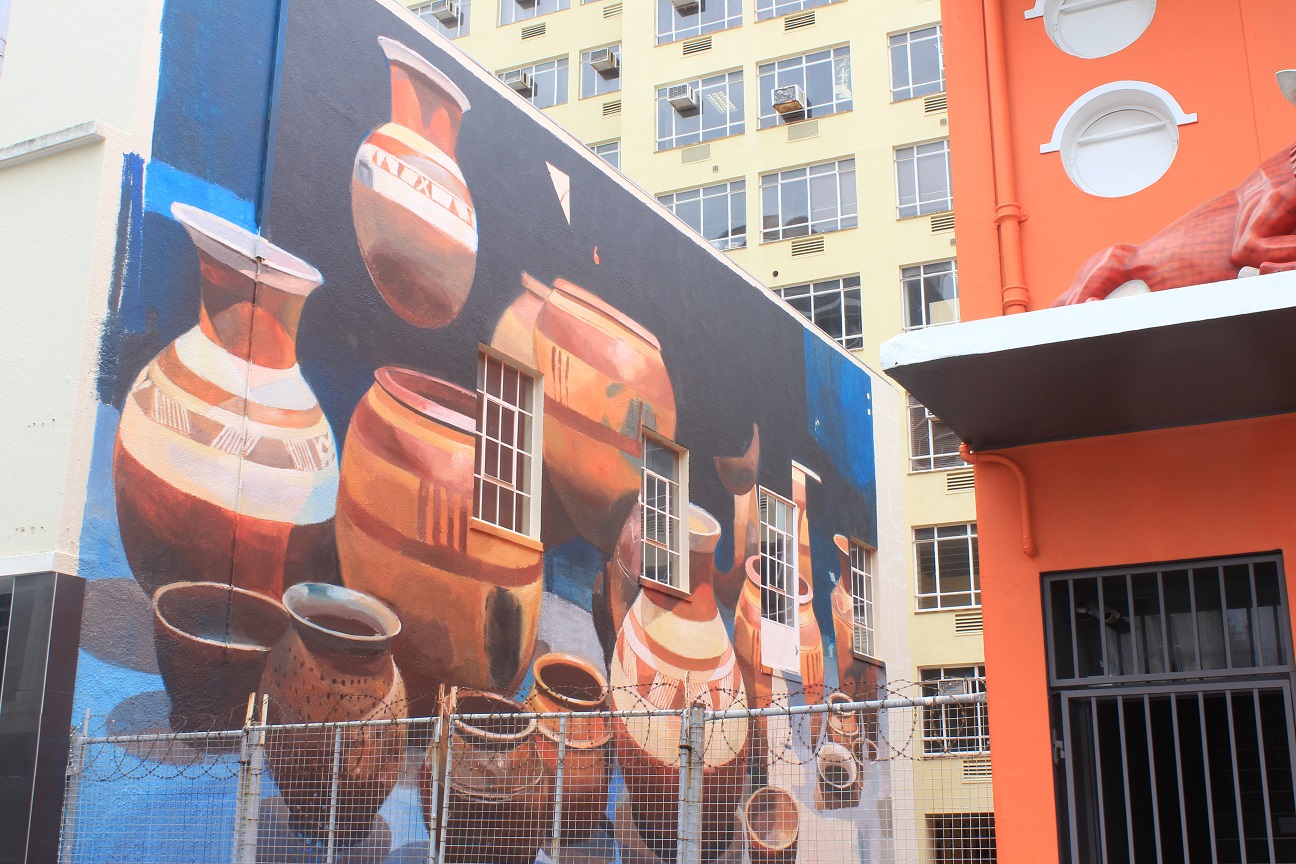
A striking new mural in Commercial Street was painted during the International Public Art Festival (IPAF).
ON THE MEND
“I would say that the art economy is on the mend,” says Jennifer Reynolds, gallery director and owner of StateoftheART in Buitenkant Street. “However, there is still a dearth of foot traffic, particularly in the East City of the CBD.” The Investec Cape Town Art Fair provided some relief as Reynolds, along with other CBD galleries, welcomed international art lovers during the three-day event.
Reynolds is excited that the IPAF was centred around Harrington Street this year, which brought people into the area. StateoftheART also formed part of festivities with artist Lisette Forsyth painting the gallery’s windows and interacting with the public.

Artist Lisette Forsyth transforms windows at StateoftheART Gallery.
MORE VISITORS TO GALLERIES
THEFOURTH gallery director, co-founder and artist Rodan Kane Hart shared similar sentiments adding: “We have seen a bustling city life and much more visitors to our gallery. We will be expecting 300 people for one event as an example.”
Georgia Stonehouse, gallery manager at 99 Loop Gallery also says they’ve seen improvements and growth month by month. “We are feeling hopeful and excited,” says Stonehouse. Like many of the CBD’s over 20 galleries that participate in the popular monthly First Thursdays event, another contributor to the CBD’s art economy, her gallery presents new shows every month and currently has a solo exhibition by Jonathan Silverman.

One of the booths at the 2022 Investec Cape Town Art Fair.
THE IMPACT OF POPULAR ART EVENTS
The Investec Cape Town Art Fair, considered Africa’s largest contemporary art showcase, returned to the Cape Town International Convention Centre (CTICC) as a hybrid event with over 300 artists exhibiting their work.
THEFOURTH and 99 Loop Gallery were two of the Cape Town CBD galleries that took part, along with EBONY/CURATED, Eclectica Contemporary, THK Gallery, A4 Arts Foundation, WORLDART and WHATIFTHEWORLD whose curator, Ashleigh McLean, says they’ve seen an uptick in international visitors and have continued to enjoy support from their local clients.
IPAF kicked off with its inaugural National Public Arts Conference at Cartel House in Loop St and various CBD venues. While the street art festival, the biggest on the African continent by Baz-Art, saw local and international artists painting massive murals reflecting on the “Humanity” theme in Harrington St in the CBD and Salt River, the three-day conference looked at contemporary issues concerning the arts sector.
Dennis Molewa, Baz-Art Marketing and Communications Manager, says this year’s festival was more special as it included the Cape Town CBD for the first time since its first edition in 2017. The move to town means new murals have been added to the street-art mix, which includes the dog in the East City, a mural on the old Madame Zingara building in Loop Street, and the lighthouse in Strand Street.

Commissioned artworks by various artists on the exterior of The Fynbos development in Bree Street.
RECONNECTING PEOPLE
Molewa says the festival not only “reconnected people in disconnected times” and empowered artists, but boosted the recovery of the tourism industry by giving local tour guides a platform to earn money.
“Street art as an art form is quite established in Europe and South America. In Africa, it is still gaining a following, but South Africa has the most cultivated street art scene with murals used to raise human rights issues and connect people.”
Other attempts to support the CBD’s art economy include efforts by CBD developers such as Lurra Capital, developer of The Fynbos, and Boxwood Property Fund. The former commissioned 10 artists late last year to paint the exterior of its site and will have the winners creating new works once the building is complete. The latter recently added large murals by Woodstock artists inside its building The FELIX (formerly known as Picbel Parkade) and continues to enliven the surrounding area.
IMAGES: CCID, StateoftheART Gallery